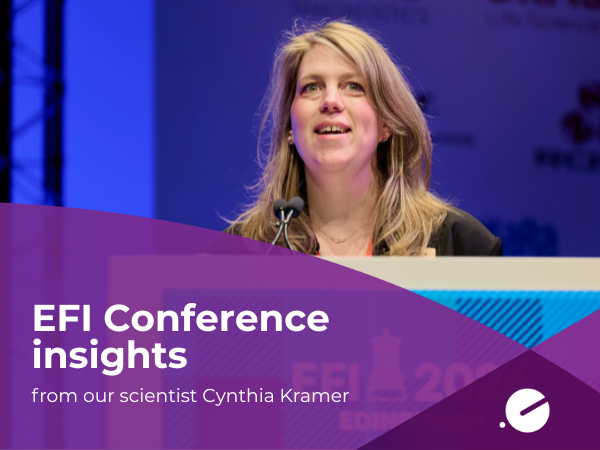
The 39th annual European Federation for Immunogenetics Conference 2026 brought together researchers, clinicians, and industry experts from around the world in Edinburgh to discuss the latest advances in immunogenetics and histocompatibility. Centered around this year’s theme, “From Genes to Grafts: Where Innovation Meets Medicine,” the conference highlighted the rapid pace of innovation shaping the field.
Our colleague Cynthia Kramer, PhD, Scientist at GenDx, attended the conference and shares her key scientific highlights below.
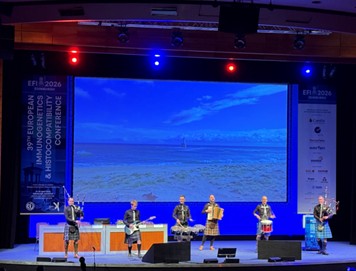
 The 39th EFI conference was held in Edinburgh Scotland, and the organizers welcomed the participants from around the world with the famous bagpipe sounds of Scotland. The theme of this year was “From Genes to Grafts: Where Innovation Meets Medicine” and overall, the meeting highlighted the importance of interaction among all fields within immunogenetics and histocompatibility.
One of the main topics was the new opportunities of hematopoietic stem cell transplantation due to post-transplant cyclophosphamide (Pt-Cy) era. These new opportunities compared to old dogmas were set out clearly by Katharina Flieschhauer. Pt-Cy has reduced GvHD incidence across all donor types and less differences in outcomes are observed between match unrelated donors (MUD), mismatch unrelated donors (MMUD), and Haplo-identical donors. As a result, the experts indicated that it would be relevant to look beyond the HLA for donor selection and start considering other factors such as donor age. Interestingly, Bronwen Shaw proposed that “for donor selection go for unrelated and family simultaneously” while Rob Wynn emphasized the importance of cord blood as donor source by “Don’t cut the Cord”.
Looking beyond HLA was a theme that repeatedly surfaced throughout the EFI scientific program. As researchers increasingly explore all aspects of the immune system and indicating how complex the immune system is and how it affects clinical outcomes after transplantation. This was evident from the number of talks delving into the immunopeptidome, T-cell receptor sequencing, killer cell immunoglobulin-like receptors (KIR), and related topics, across both basic research and clinical contexts. This further underscore the close interplay between immune system and clinical outcomes, and the importance of close collaboration between researchers and clinicians.
However, HLA remains a key player, as reflected in the many presentations on HLA loss in various clinical scenarios. Additionally, for those that are interested in investigating HLA genomic and transcriptomic disruption, Nicholas McGranahan presented a tool to detect HLA disruption named MHC Hammer and this tool has been made available (https://github.com/McGranahanLab/mhc-hammer).
In addition to immunogenetics, the program highlighted a wide range of cell-focused topics, spanning immune cell contribution to clinical outcome, cell therapy, and monitoring strategies. Wolfram-Hubertus Zimmerman gave a fascinating talk on how iPSCs are used to engineer heart muscles for heart-failure patients who have lost muscle function. On the other hand, several talks focused on engineered T-cells, such as CD19-T cells, CHAR T-cells, and CHER-T cells that can be used for therapy either in transplantation or autoimmune disease setting. Lastly, Carla Baan and her group identified donor-derived extracellular vesicles in recipient circulation as biomarker for rejection post-kidney transplantation. While further research was still required she noted that “These efforts may clarify the role of extracellular vesicles not only as biomarkers but also as modulators of kidney transplantation rejection”.
Altogether, the EFI scientific program highlighted the broad scope of immunogenetics and histocompatibility and emphasized how essential close collaborations are in advancing the field.