
In previous blog posts in this series, we introduced the central role of HLA molecules in tumor immunology and discussed how tumors can alter HLA pathways to evade immune detection and destruction. In this blog post, we explore how a patient’s HLA type may associate with the efficacy of immune checkpoint inhibitors.
Not every patient responds equally well to immunotherapy
Immunotherapy is an important treatment option for several cancer types. Rather than targeting the tumor directly, many immunotherapies aim to strengthen, restore, or redirect anti-tumor immune responses. Interestingly, some patients experience long-lasting tumor control when treated with immunotherapy, while others show little benefit or eventually develop resistance after an initial response. These differences are especially well studied for immune checkpoint inhibitors (ICIs) [1], which will therefore be the focus of this blog post.
ICIs, such as anti-PD-1, anti-PD-L1, and anti-CTLA-4 antibodies, work by releasing inhibitory “brakes” on anti-tumor T cells, as exemplified in Figure 1. However, for cytotoxic CD8+ T cells to recognize and kill cancer cells, tumor-derived peptides first need to be presented on the cell surface by human leukocyte antigen (HLA) class I molecules, specifically HLA-A, HLA-B, and HLA-C. This makes HLA a key link between tumor genetics, immune recognition, and clinical response.
When tumor antigens are effectively presented by HLA molecules, ICIs may have a better chance of reinvigorating an effective anti-tumor response. Therefore, specific HLA types, as well as the overall diversity of a patient’s HLA genotype, may affect the peptide repertoire that can be presented and thereby influence the response to ICIs. In the rest of this blog post, we will investigate different examples of how HLA may be associated with response to ICI.
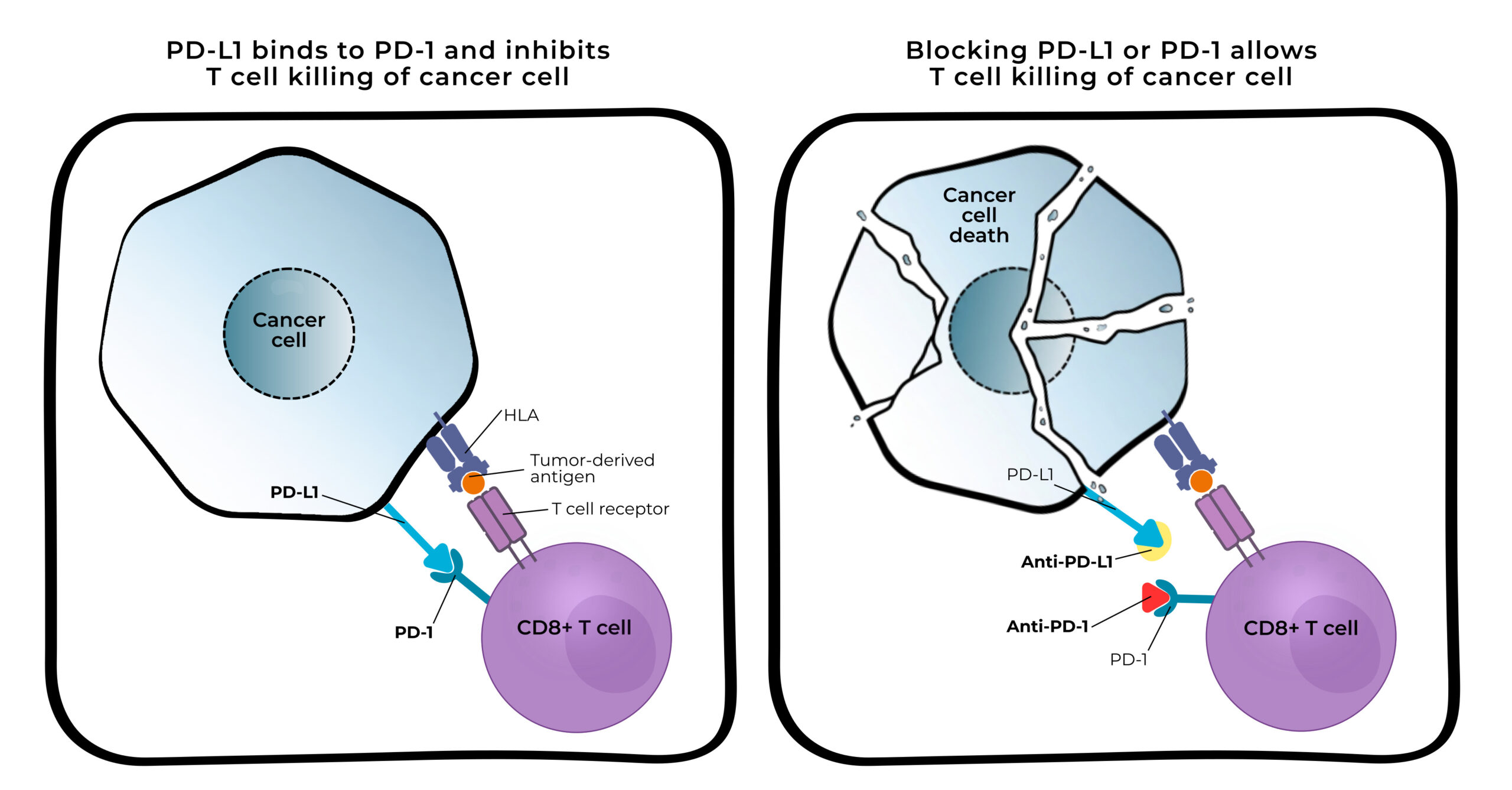
Figure 1. Example of immune checkpoint inhibitors (ICI: anti-PD-L1/anti-PD-1), illustrating how ICIs enable activation of the T cells and thereby killing of cancer cells. Figure based on [2].
Homozygosity in HLA class I may negatively affect response
For each classical HLA class I locus, patients inherit one allele from each parent. Patients who carry two different alleles at HLA-A, HLA-B, or HLA-C are heterozygous at that locus. Patients who are heterozygous across all three class I loci may be able to present a broader repertoire of tumor-derived peptides than patients who are homozygous at one or more loci. Consequently, greater HLA class I diversity may give the immune system more opportunities to recognize cancer cells. Although this association is not observed in all studies and even the opposite is observed in one study [3], several cohorts have reported poorer ICI therapy outcomes in cancer patients who are homozygous for at least one HLA class I locus [1].
For example, in a cohort of patients with advanced non-small cell lung cancer treated with three different single-agent PD-1/-PDL1 inhibitors, homozygosity at at least one HLA class I locus was associated with shorter overall survival (OS) [4]. OS is the time from treatment start until death from any cause. Additionally, homozygous patients in this study showed a shorter progression-free survival (PFS), which is defined as the time from treatment start to disease progression or death.
Another study investigated patients with advanced esophageal squamous cell carcinoma who were treated with camrelizumab (an anti-PD-1 antibody) [5]. In that cohort, patients with homozygosity at one or more HLA class I loci had a lower overall response rate (ORR) than patients who were heterozygous across HLA class I loci. ORR is defined as the percentage of patients whose tumor(s) shrink or disappear after treatment. PFS and OS were also shorter in homozygous patients.
High HLA evolutionary divergence as a beneficial factor
Heterozygosity is not the only factor that determines the diversity of HLA molecules in a patient. In a patient who is heterozygous for an HLA locus, the two alleles can either be very different or very similar. This (dis)similarity of the HLA alleles is described by the HLA evolutionary divergence (HED). HED measures how different the two alleles at a given HLA locus are, particularly in regions that shape peptide binding and thus peptide presentation to T cells. High HED is thought to broaden the range of tumor peptides that can be presented to T cells and has been associated with improved outcome of ICI treatment in several studies [1,6].
For example, higher HED was associated with longer OS in cohorts of patients with metastatic melanoma or non-small cell lung cancer treated with CTLA-4, PD-1, or PD-L1 inhibitors [6]. Another study investigated patients with advanced renal cell carcinoma treated with pembrolizumab, an anti-PD-1 ICI, plus lenvatinib, a multi-kinase inhibitor [7]. In this cohort, high HED was associated with longer PFS and a longer duration of response. Together, these studies illustrate the possible association between high HED and improved ICI outcomes.
Specific HLA alleles can influence response
Interestingly, not only HLA diversity, but also specific HLA alleles or supertypes have been associated with immunotherapy outcomes. Some alleles have been associated with poorer response, whereas others have been associated with more favorable outcomes in specific cohorts. The mechanisms behind these associations are not yet fully understood. Possible explanations include differences in peptide-binding repertoire, tumor antigen presentation, and other immune-related genetic factors.
For example, across several large cohorts of patients with advanced cancer treated with PD-1, PD-L1, or CTLA-4 inhibitors, HLA-A*03 was associated with poorer outcomes, including shorter OS and PFS, and lower ORR [8]. In contrast, a study of advanced esophageal squamous cell carcinoma patients associated the HLA-B27 supertype [9] with more favorable outcomes [5]. In patients treated with camrelizumab, the HLA-B27 supertype was associated a longer OS.
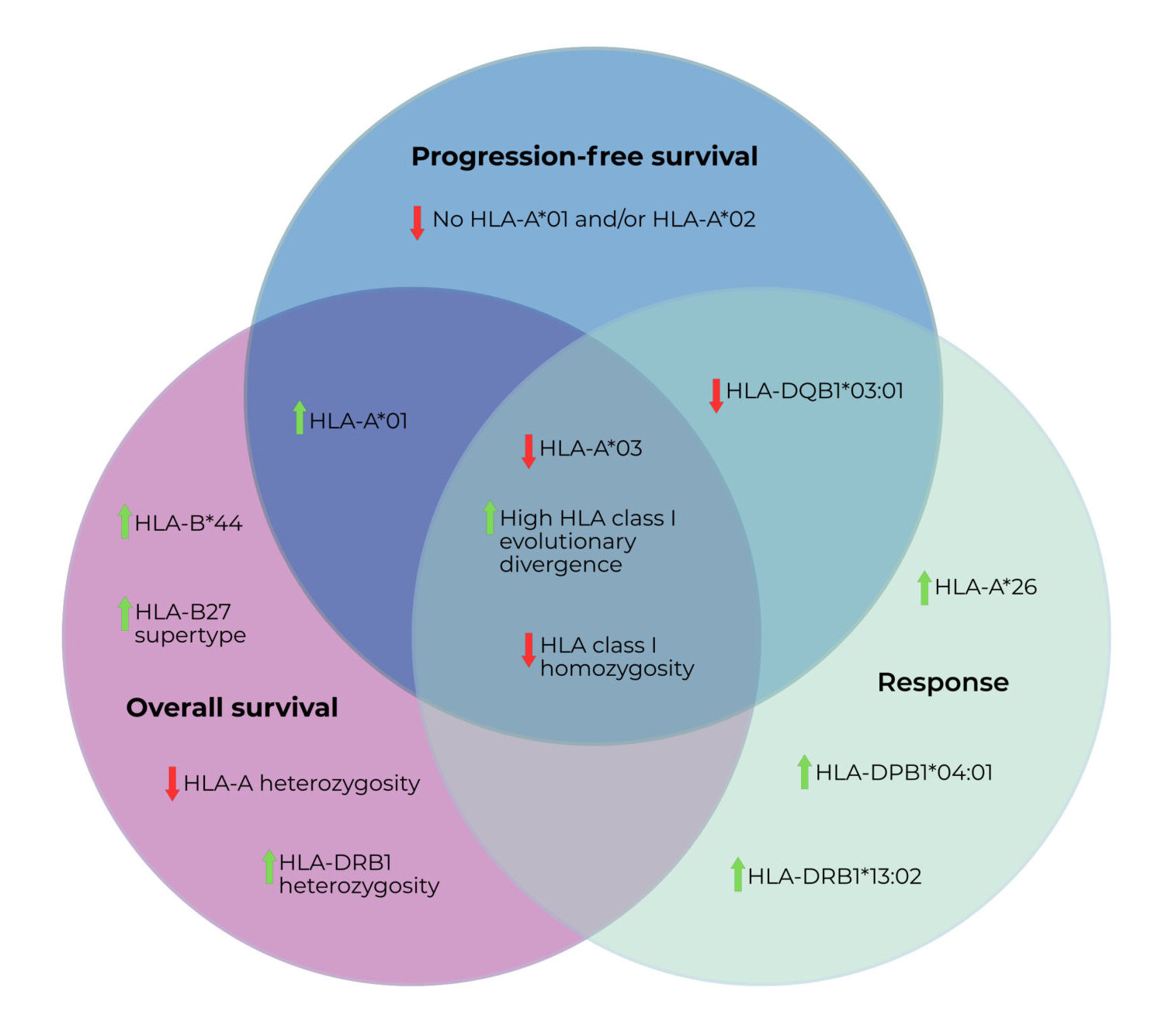
Figure 2. Examples of beneficial (green arrows) and disadvantageous (red arrows) associations between HLA alleles and treatment of tumors with ICI that were found at least once for specific tumors and treatments. Summarized from [1], in which a more extensive and detailed overview is presented.
HLA testing may support precision immunotherapy
The examples described in this blog post illustrate why HLA genotyping may be relevant in immunotherapy studies, particularly when analyzing differences in ICI response between patients. Figure 2 shows several of the reported associations between HLA genotype and ICI outcomes and is more extensively reviewed in [1]. Importantly, this review also highlights that these associations are not observed consistently across all studies and may depend on tumor type, treatment regimen, disease stage, and other clinical or molecular factors. At the moment, the associations between HLA and ICI responses are promising, but they are not yet strong enough to guide treatment decisions on their own.
Further research in this field may clarify when HLA genotype adds clinically useful information beyond biomarkers such as PD-L1 expression, tumor mutational burden, or HLA-I expression. Clarity on this topic may add another layer of information when assessing whether a patient’s immune system is likely to recognize and respond to cancer cells during ICI treatment. In the future, combining germline HLA typing with tumor HLA expression, HLA loss status, antigen-processing markers, and established biomarkers may help improve prediction of ICI responses.
The biological causes of these differences in treatment response remain incompletely understood. One possible explanation is tumor HLA loss. If a tumor loses expression of specific HLA molecules, its ability to present tumor antigens may be reduced. This loss may be especially consequential in patients whose inherited HLA class I is already limited. In the next blog post in this series, we will dive deeper into tumor HLA loss and its clinical relevance.
Authors:
Cindy Spruit – Technical Writer
 Cindy holds a PhD in molecular biology. She currently works on both Companion Diagnostic and Research & Development projects in her role as a Technical Writer at GenDx. She is responsible for coordinating and writing documents that are required for, among others, performance studies and regulatory submissions.
Dirk Geerts – Senior Project Manager R&D Oncology

Dirk has a PhD in molecular genetics. He coordinates several oncology projects ranging from early diagnostic development to marketed diagnostics.
References:
[1] de Joode, K., Heersche, N., Basak, E. A., Bins, S., van der Veldt, A. A., van Schaik, R. H., & Mathijssen, R. H. (2024). Review–The impact of pharmacogenetics on the outcome of immune checkpoint inhibitors. Cancer Treatment Reviews, 122, 102662.
[2] National Cancer Institute. (2022, April 7). Immune checkpoint inhibitors. https://www.cancer.gov/about-cancer/treatment/types/immunotherapy/checkpoint-inhibitors
[3] Correale, P., Saladino, R. E., Giannarelli, D., Giannicola, R., Agostino, R., Staropoli, N., … & Tagliaferri, P. (2020). Distinctive germline expression of class I human leukocyte antigen (HLA) alleles and DRB1 heterozygosis predict the outcome of patients with non-small cell lung cancer receiving PD-1/PD-L1 immune checkpoint blockade. Journal for Immunotherapy of Cancer, 8(1), e000733.
[4] Abed, A., Calapre, L., Lo, J., Correia, S., Bowyer, S., Chopra, A., … & Gray, E. S. (2020). Prognostic value of HLA-I homozygosity in patients with non-small cell lung cancer treated with single agent immunotherapy. Journal for ImmunoTherapy of Cancer, 8(2), e001620.
[5] Wang, L., Zhu, Y., Zhang, B., Wang, X., Mo, H., Jiao, Y., … & Huang, J. (2022). Prognostic and predictive impact of neutrophil‐to‐lymphocyte ratio and HLA‐I genotyping in advanced esophageal squamous cell carcinoma patients receiving immune checkpoint inhibitor monotherapy. Thoracic Cancer, 13(11), 1631-1641.
[6] Chowell, D., Krishna, C., Pierini, F., Makarov, V., Rizvi, N. A., Kuo, F., … & Chan, T. A. (2019). Evolutionary divergence of HLA class I genotype impacts efficacy of cancer immunotherapy. Nature medicine, 25(11), 1715-1720.
[7] Lee, C. H., DiNatale, R. G., Chowell, D., Krishna, C., Makarov, V., Valero, C., … & Chan, T. A. (2021). High response rate and durability driven by HLA genetic diversity in kidney cancer patients treated with the immunotherapy combination lenvatinib and pembrolizumab. Molecular cancer research: MCR, 19(9), 1510.
[8] Naranbhai, V., Viard, M., Dean, M., Groha, S., Braun, D. A., Labaki, C., … & Carrington, M. (2022). HLA-A*03 and response to immune checkpoint blockade in cancer: an epidemiological biomarker study. The Lancet Oncology, 23(1), 172-184.
[9] Sidney, J., Peters, B., Frahm, N., Brander, C., & Sette, A. (2008). HLA class I supertypes: a revised and updated classification. BMC immunology 9(1), 1.