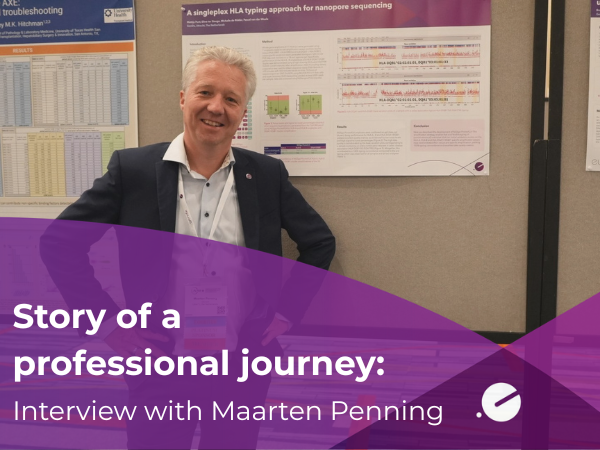
There is always an interesting story behind each one of us as well as the people we work with. That’s why today we interviewed our General Manager, Maarten Penning, to learn more about his professional journey, including the challenges and the successes that have shaped his path.
We will share the interview below:
- Can you walk me through your professional journey (study, internship, first job) and how you ended up as a general manager at GenDx?
I studied in Wageningen at the agricultural university. And why I chose this study? That is because after my high school, I knew that I wanted to do something related to life sciences or chemistry but I didn’t know exactly what. Instead, with this study, called molecular sciences, I could get a bit of everything. I could even do computer programming. In this way, I could choose all courses I liked. At the end I turned out to be a molecular biologist. Now, looking back, during high school, I was trying to breed the nicest fishes. That has to do with molecular biology and genetics. So it was probably supposed to go in that direction.
Then at the end of my study, I conducted three practical periods. The first two were at the university and the last one at a company. The first study was about fungi where I was trying to breed fungis with a certain resistant gene. During the second practical period, I worked with the cowpeau mosaic virus. We investigated how it was moving from a plant cell to the next one, so we needed to do cloning and develop an assay to detect the virus. The last practical period was the most interesting. I worked with a company (Introgene) that turned out to be one of the most successful Dutch life sciences companies (Crucell). They were developing gene therapy for cystic fibrosis.
After my study, finding a job was a bit more difficult than expected. I applied for different PhDs. But I really wanted to do something related to patients. I think that as I did not have much medical knowledge, it was difficult to find a PhD that I liked. At the end, I was hired at the academic medical center in Amsterdam thanks to my experience in sequencing. At that time, it was still old fashioned, with radioactive gels and manual read out. The whole department was working on HIV except for me and another colleague. We studied Hepatitis B and C viruses. I developed assays to detect the virus before people got ill. I also developed assays to predict resistance to the therapy. When I finished my PhD, it was clear for me that I didn’t want to stay in the academic world because of the politics playing there. I didn’t feel that was the right place for me. After that, I received a job offer from Primagen, which was located nearby the Amsterdam medical center. I worked there as a project manager in oncology. The team had identified markers indicating blood vessel growth in a sarcoma skin cancer they were studying.
We hypothesized that if a tumor anywhere in the body is growing, blood vessel formation would eventually occur. These markers could potentially be used to detect the presence of a tumor. My role was to develop an assay together with a team of technicians. I also set up various collaborations with academic institutions, researchers and companies. This way, we could test the markers in a real-world environment.
After 4 years, the shareholders decided to stop funding this company so we stopped with our work. But through this job, I had come in contact with another company that took over some of the people and labs. I was hired as a team manager. This company was focusing on DNA methylation and more specifically on glioblastoma (a certain brain tumor). We could predict which patients would benefit from a new therapy. We also developed an assay for prostate cancer. I stayed here for four years as well. I looked for a new position in molecular diagnostics and this is how I ended up at GenDx. So it is really by accident that I work in the transplant field. I am not an expert in immunology or HLA but I know a lot about developing molecular diagnostics and I apply that knowledge to the transplant field.
-
What drew you to this field initially, and what keeps you motivated?
I realized during my practical periods in gene therapy that I got a lot of motivation from that. This is because you know that, when it is successful, you help people that wouldn’t survive otherwise. This is what motivates me still today: What we do at GenDx really helps critically ill patients.
-
Were there any specific moments or decisions that significantly shaped your career trajectory?
Seeing all that politics in the academic world helped me to understand that I didn’t want to become a professor or do fundamental research, but that I wanted to work for a company. An other moment was when I was working for Primagen, setting up all the collaborations with different stakeholders, I realized that I really like that, even more than working in a lab.
-
What technical or scientific skills do you think were most critical in advancing your career?
Yeah, its difficult to say but I was hired ultimately because I knew sequencing so that was a crucial skill for me to have. Otherwise I wouldn’t end it up in that lab at the medical centre in Amsterdam.
-
What leadership or management skills have been essential in your current role?
Well, I have heard people giving me two types of compliment. One is that I can think out of the box. For example, if someone has a rigid way of thinking, I can come up with alternative scenarios or insights. And the other thing that people have told me is that I am a good storyteller. I like to explain the ‘why’ behind what we do. I don’t like to just give directions but explain why that is needed etc..
-
What do you enjoy the most in your current role?
Maybe two things: discuss with multiple stakeholders and hearing positive feedback from cutomers about our products, our support (for example during conferences) and this makes me very proud. Another thing I like is walking into the café and seeing it packed, with everyone chatting, or seeing pictures on Signal of people having fun together outside of work. It’s really like… it’s good to see that we have such a great team spirit. And this is something that external people have noticed as well.
-
Can you share a mistake or difficult situation that taught you an important lesson in your professional development?
First thing that comes to mind is during my study, I was conducting a multi day experiment. At certain points, you had to take samples and store it in the freezer. We marked every sample as 1, 2, 3 during the week. Of course, at the end we didn’t know anymore what sample was from which day. So I learned, working in the lab is to do a proper administration and work neatly. This is a typical mistake that everyone working in a lab makes at least once.
Looking later in my career: there are two things that popped in my mind. The first one: while I was working for Primagen, it happened a couple of times that all personnel was informed that it was not sure if there would be enough money to pay the salaries next month. This is why now I find it important to be transparent to our colleagues about the financial situation at GenDx and share other important updates in our monthly office meetings.
A later lesson is that we started a collaboration with a party without aligning the expectations upfront. The collaboration turned out to be a disaster. So it is important to have at least some kind of mutual understanding to begin with.
-
From your perspective, how has the HLA/molecular diagnostics field evolved, and what opportunities does that create for professionals?
We see that technology is evolving rapidly: we learn more and more about the biology, but also we have more computational power and can analyze increasingly complex data. Because of these developments, our field is developing rapidly, which makes it super interesting to be active in this field in the current time. Sometimes I try to imagine where this will lead—some people believe that in a few years, a single drop of blood could tell you everything about a person. I think diagnostic assays will remain important and necessary. For example, they will be needed to monitor illness, or therapy effects. I believe GenDx is in a strong position because we develop both software and reagents. We have expertise in data analysis and are now also exploring artificial intelligence. This puts us near the forefront of developments in both technology and biology. As a consequence, I think it helps if young professionals have an affinity with both software and the biology.
-
Looking ahead, what skills or areas should emerging professionals focus on to grow in this field?
Stay curious and keep an investigative mindset – don’t take things for granted.
I believe it is important and often more efficient to have personal interactions. So pick up your phone or walk to your colleague’s desk instead of sending thousands of emails or messages. Just call the person or walk to your colleague’s desk to discuss face to face.